Our Kitchen Collection 2025

By Style
By Colour
Why Deelux
Handleless vs Shaker vs In-Frame: Which Kitchen Style Suits?
21st April 2026Almost every kitchen we design lands in one of three door styles: handleless, Shaker, or in-frame. Each one tells you something different about the room the moment you walk in, each one comes with a different price and maintenance story, and each one suits a different kind of house. Here’s how we help customers choose.
The quick comparison
| Style | Look | Typical price band | Best for |
|---|---|---|---|
| Handleless | Minimal, modern, calm | £££ | New builds, clean-lined homes, open plan |
| Shaker (lay-on) | Classic but uncluttered | £££ | Family homes, most UK properties |
| In-frame | Substantial, traditional, hand-made | ££££ | Period properties, larger rooms, statement kitchens |
Handleless: the modern calm
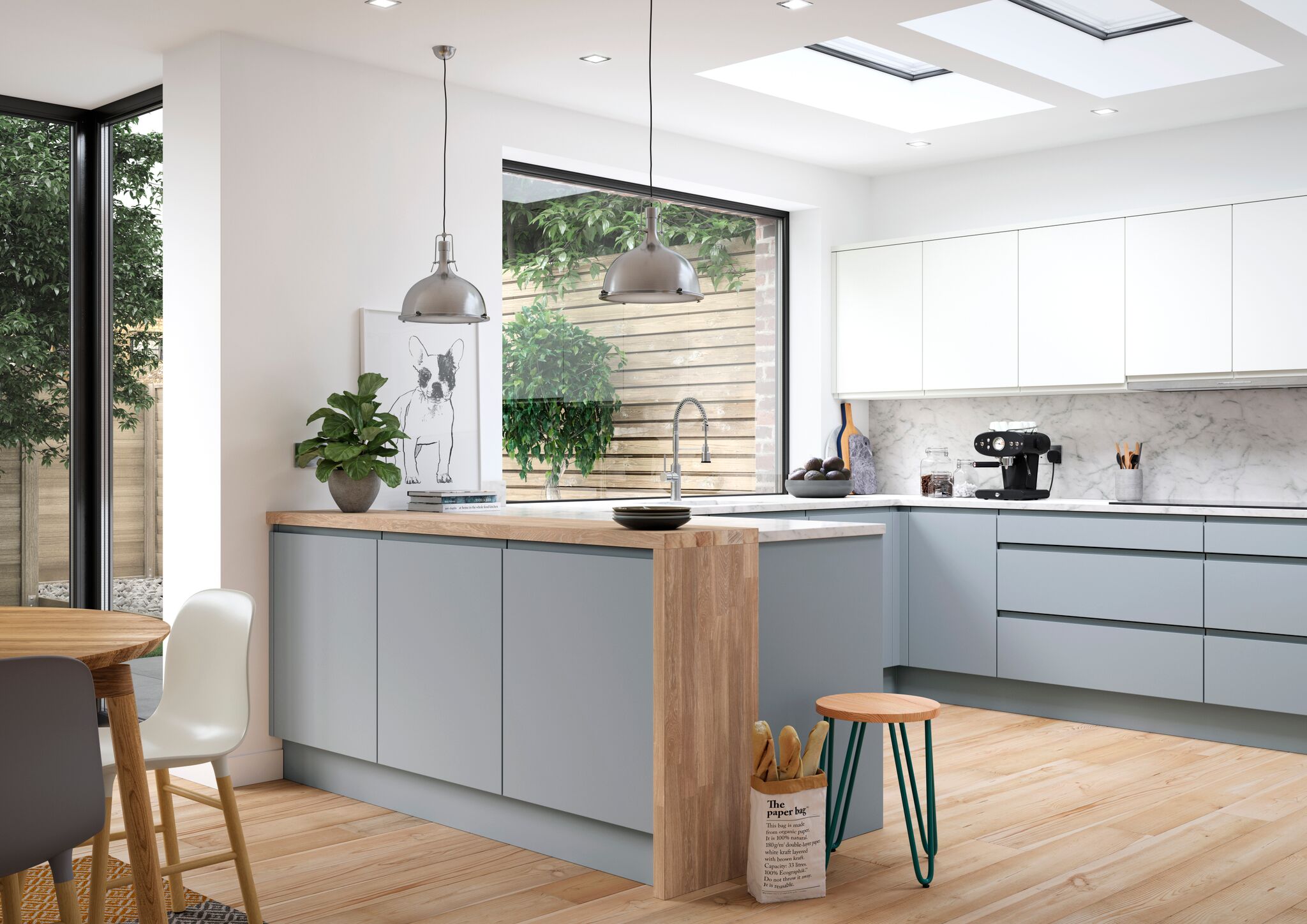
A handleless door has no knob, no D-bar, no projecting handle. The door is opened via a recessed rail (true handleless, like our Pollino True Handleless), a grooved top edge (J-pull) or a push-to-open mechanism. The result is a continuous, uninterrupted plane of cabinetry.
Why people pick it: it photographs clean, it feels quiet in the room, it’s easy to wipe down, it suits open-plan kitchens where the cabinets are visible from the living area.
The trade-off: the recessed rail on a true handleless kitchen is the bit that gets dirty. A quick wipe every day keeps it sharp; let it go for a fortnight and it shows. Push-to-open mechanisms are neat but mean you can’t slam a drawer shut without it re-opening.
Best in: modern houses, open-plan kitchen-diners, and kitchens where the owner wants the furniture to disappear into the architecture.
Shaker (lay-on): the all-rounder
Five-piece door, flat centre panel, no mouldings, sits on the face of the cabinet. The style that refuses to date. Our Mollingdon range is a painted lay-on Shaker.
Why people pick it: it looks “right” in 90% of UK homes. It isn’t aggressively modern or aggressively traditional. It takes any colour. It welcomes handles — brass, matt black, leather pull, ceramic knob — so you can tune the mood after the kitchen goes in.
The trade-off: it’s not a statement. If you want a kitchen that makes guests stop in the doorway, a lay-on Shaker isn’t it.
Best in: family kitchens, Victorian and Edwardian terraces, extensions that want to feel “part of the house” rather than a contrast.
In-frame: the real deal
The Shaker door, but set inside a visible hardwood face frame on every opening. You see a grid of frame around every cabinet. The Falconbrook In-Frame range is our in-frame flagship.
Why people pick it: it feels unmistakably hand-made. It has weight. It suits period properties where a lay-on kitchen can feel too light. And it’s the style that most shows off hand-painting — the frame itself becomes a canvas.
The trade-off: cost. Every opening is effectively hand-fitted, which doubles build time. You also lose a small amount of internal cabinet volume to the frame — a detail that matters in a small kitchen but is trivial in a large one.
Best in: period properties, larger rooms, kitchens where the owner wants to see and feel the craftsmanship.
Maintenance: what’s actually different
- Handleless: wipe the rail daily. Painted rails are easier than stainless steel.
- Shaker: the edges of the five-piece door are the places paint chips first. Keep a touch-up pot of the original paint in the cupboard under the sink.
- In-frame: same as Shaker, plus the face frame itself. A hand-painted in-frame kitchen looks best if it’s repainted every 10–15 years — a weekend’s work, not a full replacement.
Cost: the honest version
Rough comparison at 7-unit kitchen scale, UK 2026:
- Handleless lay-on: from £11,500 (Pollino True Handleless).
- Shaker lay-on, painted: from £11,000 (Mollingdon).
- In-frame, hand-painted: from £14,000 (Falconbrook In-Frame).
Finishes, worktops and appliances all move the total well beyond the cabinet cost, but the door style is the single biggest cabinet-level variable.
How to decide without visiting a showroom
Honestly, you can’t — not with any confidence. All three styles photograph flatly. In person, the difference in weight and shadow between a Shaker and an in-frame is obvious. Spend 20 minutes in a showroom before committing either way.
All three styles on display at Chester showroom, Nantwich showroom and Warrington showroom. Every quote includes free 3D visuals of your kitchen in your chosen style. Related: modern kitchens, traditional kitchens, hand-painted finish.

Interior Design Service
We are on hand to help you choose wall colours, fabrics, flooring and much more.
Are you thinking of having an extension? Bring in your architect's plans and we can begin to design your dream kitchen. We can undertake as much of the project as you like from supplying and installing to fully project managing your kitchen. Get in touch today to start your kitchen adventure with Deelux.
Design Service